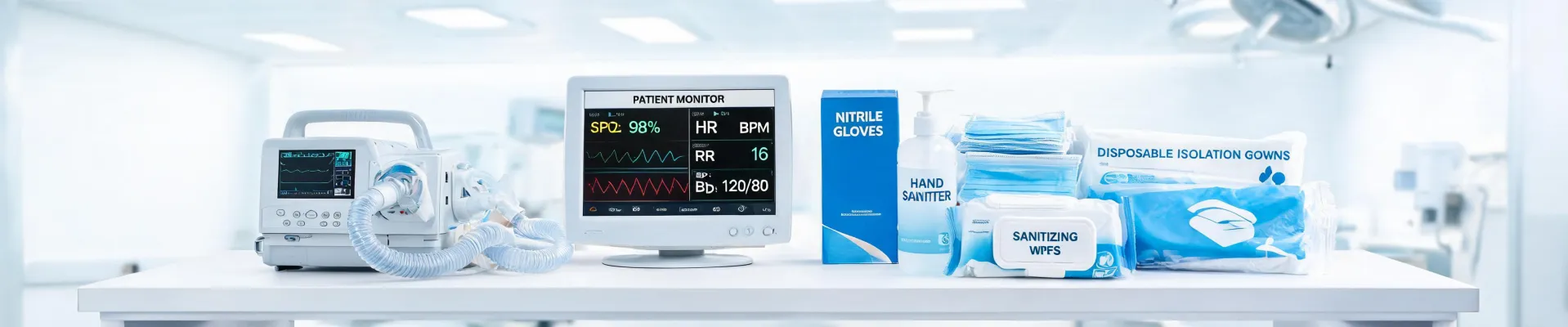
I've been buying medical equipment and supplies for a regional health system for six years. I don't set ventilator parameters or run clinical trials. My job is to make sure the hospital buys the right technology without treating every order as a commodity.
That job got harder after 2020. What was best practice back then does not always apply in 2025. But the fix is not to replace every old device or standardize everything. It's knowing which of three buying scenarios you're in. If a sales rep tells you there is a universal answer for hospital disinfectant purchases, patient monitor selection, or surgical staplers, you should be suspicious. There isn't one.
Start here: three buying scenarios
In my spreadsheets, I split major requests into three buckets:
- Scenario A: Capital replacement. You're replacing aging ventilators or patient monitors. The decision is about service cost, training, integration, and long-term cost.
- Scenario B: Supply cost pressure. Your hospital disinfectant or surgical stapler spending is rising faster than surgical volume. The decision is about usage patterns, labor, and hidden costs.
- Scenario C: Expansion or a new service line. You're adding beds, building an OR, or launching a new clinical service. The decision is about phasing and system integration.
The biggest mistake I see is applying the same logic to all three.
Scenario A: Ventilators and patient monitors
If clinical engineering is spending more time maintaining ventilators and monitors than care teams spend using them, you're in Scenario A.
Ventilators are the most obvious example. When I read Hamilton Medical ventilator news, I am not looking for marketing. I look for service bulletins, software updates, ventilator circuit compatibility, and how the new platform will fit with training. A new model can be clinically excellent but still fail at 2:00 a.m. if your respiratory therapists did not have enough hands-on time.
The first mistake is comparing only the sticker price. My cost review includes the purchase price, a five-year preventive maintenance estimate, replacement batteries, consumables, training, and the downtime cost during install. That one change usually turns a ventilator quote from a simple deal into a more complicated story.
The same is true with a patient monitor. At the cheap end, it's a transport monitor that measures basic vitals. At the top end, it's a networked system with invasive pressure, cardiac output, and electronic medical record integration. You are not buying the same thing.
Watch the accessories. Monitor cables, SpO2 sensors, blood pressure cuffs, batteries, mount arms, and interface licenses can add a lot to the total cost. I now ask every vendor for accessory list prices before I recommend a purchase. The monitor is only the beginning.
One more thought: if you are under time pressure, put an escape hatch in the contract. In late 2024, we had two weeks to approve a patient monitor rollout before pricing expired. Normally I would have wanted a 30-day pilot. There was no time, so I made the agreement contingent on pilot results at one unit. That is not a perfect process, but it is the honest one.
Scenario B: Hospital disinfectants and surgical staplers
Scenario B is less interesting but often hides more money. It includes hospital disinfectant and surgical staplers. They get reordered month after month without data being challenged. That silence is expensive.
Let me start with hospital disinfectant. The typical mistake is comparing products by price per gallon or price per wipe. That ignores contact time: the amount of time a surface must stay wet to make the kill claim on the label.
A product with a two-minute contact time is very different from one that needs ten minutes. If housekeeping staff has to keep a surface wet for ten minutes, the labor cost per room goes up. A cheaper disinfectant can become more expensive after you add that labor. One of the reasons infection prevention and procurement fight is that they are looking at different numbers.
Check whether the product's claim fits the risk. EPA has lists for specific pathogens. For example, List K is for products effective against C. difficile spores. If you do not need a C. diff sporicidal claim, you should not be paying for it automatically. If you do need it, the cheapest option may not have the claim. That isn't marketing fluff; it's the label.
Now for the OR question that sounds too simple: what is a surgical stapler? In plain terms, a surgical stapler is a handheld medical device that places sterile staples to close tissue. Some are used on skin, and some are used inside the body to seal bowel, lung, or other tissue during surgery. Think of it as a system, not a one-time item.
Most of the cost sits in the cartridge or reload, not in the handle. That changes how you negotiate. A vendor can lower the handle price and still make a healthy margin on every case. I do not choose a surgical stapler on handle price. I ask about reload cost, staple sizes, training, and what happens when a surgeon needs a different cartridge quickly.
Switching a surgical stapler vendor based only on price can create a problem that no spreadsheet shows. I learned this the hard way when I tried to move a service line to a lower-cost system. The surgical pushback was intense. It was not just stubbornness. The staple height and tissue thickness did not fit the cases. Price matters, but it has to be measured after the clinical team has tested the device, not before.
Scenario C: Expansion and new service lines
If you're opening a new ICU, building operating rooms, or adding an outpatient surgery center, you're in a different game. The biggest risk is not the unit price. It's integration.
Consider a facility like Hamilton Medical Center in Dalton, Georgia. When a regional hospital adds a tower or a new service line, patient monitor decisions are connected to construction timelines, power, data networks, nurse call, and staff training. You can save money on the devices and lose more than that in delays because the installation sequence was not planned. In expansion projects, I buy in phases and keep a separate budget for commissioning and training.
This is the scenario where technology choices become system choices. Do not buy equipment in a vacuum.
How to tell which scenario you're in
Pull your last four quarters of purchase data and ask three questions:
- Is the request for a depreciable capital asset like a ventilator or patient monitor? Scenario A.
- Is it an item that is reordered monthly, like hospital disinfectant or stapler reloads? Scenario B.
- Is it tied to a construction date or a new service launch? Scenario C.
Also look at who comes to you for approval. If clinical engineering and respiratory therapy show up together, treat it as capital replacement. If the operating room director or EVS manager complains about supplies, focus on Scenario B. If a project manager keeps mentioning deadlines, you're in Scenario C.
What you do not want is to use a supply contract to solve a capital problem, or a capital process to solve a supply problem.
Bottom line
There is no standard 2025 answer for medical equipment buying. But there is a standard method: calculate real cost over time, include labor and integration, test before you standardize, and stop letting the vendor's category define the decision.
When you see Hamilton Medical ventilator news or FDA updates, ask how they affect service and training for your own team. When you choose a hospital disinfectant, ask how contact time affects the staff who actually clean the rooms. When someone asks what is a surgical stapler, ask them to show the total cost per case, not just the handle price.
The details change. The discipline does not.

Elena Varga
Elena Varga is a medical imaging systems analyst covering CT scanners, MRI systems, ultrasound platforms, digital radiography, mammography, and ophthalmic imaging equipment. She references IEC 60601-2-44 for CT safety and essential performance while examining CTDIvol, dose-length product, spatial resolution, slice thickness, field uniformity, throughput, uptime, and DICOM interoperability. Her work helps radiology leaders, medical physicists, biomedical engineers, and procurement teams compare image quality, radiation management, workflow integration, serviceability, and lifecycle cost.