-
Who this checklist is for
-
Step 1: Start with the clinical requirement, not the product catalog
-
Step 2: Verify the regulatory path before price gets discussed
-
Step 3: Map the consumable dependency
-
Step 4: Check the quality system and the failure history
-
Step 5: Run the patient monitor test under real conditions
-
Step 6: Calculate total cost over three years
-
Step 7: Run a pilot before you commit volume
-
Common mistakes worth avoiding
Who this checklist is for
I manage ICU equipment and consumable procurement for a 200-bed regional hospital. Roughly $2.4M annually across 14 vendors and seven product categories — patient monitors, infusion pumps, ventilators, hematology analyzers, incontinence products for our extended care wing, and the consumables that go with all of it. I report to clinical operations on one side and finance on the other.
This is the seven-step checklist I run before any ICU device order goes out. In the order I actually use them — not the order a sales rep walks you through.
Step 1: Start with the clinical requirement, not the product catalog
My first two years in this role, I did this backwards. I'd start with a vendor's spec sheet, compare models, negotiate a price, then ask nursing if it fitted their workflow. That's how we ended up with a patient monitor fleet that measured almost everything we needed — except the one parameter our rapid-response team relied on.
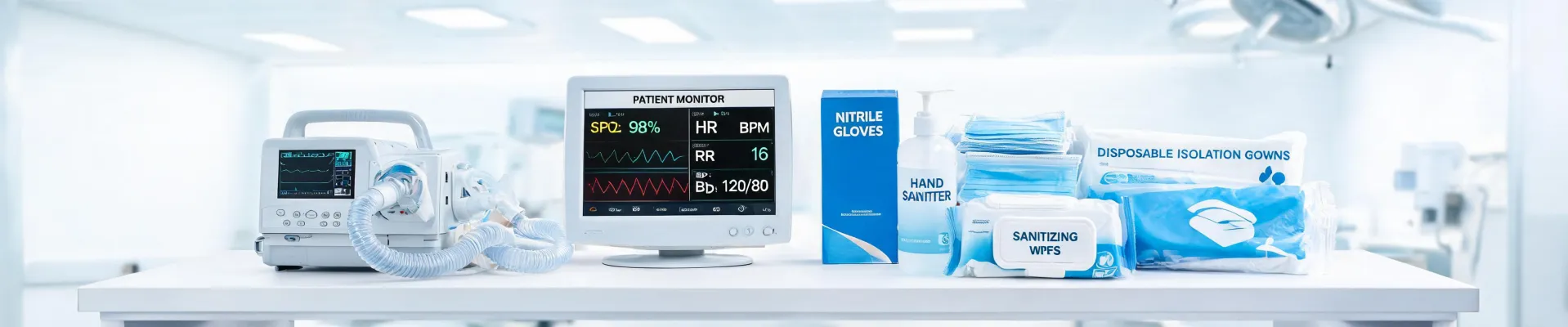
Here's the thing about patient monitors. The spec sheet says they measure ECG, SpO2, NIBP, respiration, temperature — and on higher-acuity units, invasive blood pressure and EtCO2. But "what does a patient monitor measure" isn't really the question. The question is what does it measure accurately under the conditions your unit actually runs in. Motion. Low perfusion. Alarm fatigue.
So I ask the charge nurse which readings get ignored because the sensor is slow or the threshold is annoying. That's your real spec.
Learn the difference between what a device can measure and what your clinicians will actually use. The gap between those two is where procurement budgets go to die.
Step 2: Verify the regulatory path before price gets discussed
Every ICU device in the US has a regulatory classification. A 510(k) clearance, a PMA, or a Class I listing. If a vendor can't produce the clearance number in under 30 seconds, that tells you something about how they operate.
I learned this after a 2022 evaluation where a distributor kept saying "FDA registered" but never produced a 510(k) number. Turned out the device was registered as a Class I accessory — not the Class II infusion pump we thought we were buying. We caught it before signing, but only because I'd started demanding the number on every quote.
Now I ask three things: the FDA clearance number, the regulatory class, and whether the vendor is the OEM or a reseller. That last question matters more than most buyers realize. ICU Medical, for example, operates as both an OEM and through distributor relationships in certain product lines. Knowing who holds the regulatory submission tells you who's accountable when something goes wrong.
Step 3: Map the consumable dependency
This is the step almost everyone skips. ICU equipment doesn't run on capital alone. Patient monitors need lead sets. Infusion pumps need specific administration sets. And if you're sourcing a proprietary component — an ICU Medical Lopez valve, a specialized needle-free connector, a monitor-specific sensor — that component is only the entry point. There's a whole consumable chain attached.
Before I commit to a device, I ask for a 12-month consumable projection at our patient volume. Then I check two numbers: the current price per consumable, and the vendor's history of price changes. If a device is priced 20% below market but its proprietary sets are 40% above, the savings evaporate in about six months of normal use.
To be fair, proprietary systems sometimes deliver real value. Drug libraries, dose-error reduction software, EHR interoperability — none of that is free to build. But you should know what you're buying into before the contract, not after.
Step 4: Check the quality system and the failure history
Ask for ISO 13485 certification. That's the quality management standard for medical devices — not a performance guarantee, but evidence that the supplier has a documented, independently audited quality process.
For hematology analyzers and infusion devices especially, I also check the FDA's MAUDE database. If there's a pattern of reported failures against a product line, I want to know that before the purchase order, not from an incident report three months later.
Step 5: Run the patient monitor test under real conditions
I ask for a demonstration under two conditions that match our floor: motion artifact and low perfusion. If a vendor won't set that up, I note it and weight the proposal accordingly.
I'll be blunt: a monitor that reads a perfect SpO2 on a healthy volunteer but loses signal on a patient with cold extremities is meeting the spec sheet, not the clinical requirement. Those are different things, and the difference is what you're actually paying for.
Step 6: Calculate total cost over three years
Every quote goes through a three-year total cost model: purchase price, installation, consumables at our volume, training and retraining, service contracts, and expected downtime.
I ran this model once on three infusion systems that looked nearly identical on paper. The numbers pointed to the cheapest purchase price — about 15% below the others. My gut said something was off about their service response history. I pushed for a pilot anyway. Within the first week, our night shift flagged that the alarm volume couldn't be adjusted below a threshold that woke patients in adjacent rooms. We went with the second-cheapest option. Don't hold me to the exact figures, but the three-year difference came out around 15% in favour of the one we chose — once you factored in the workarounds the cheap pump would have required.
Step 7: Run a pilot before you commit volume
If a vendor won't support a 30–60 day pilot on a small number of units, I assume they know something about floor performance they haven't told me.
For monitors, a pilot means 10–15 units in one ICU for a month. For infusion, one medication workflow. For incontinence products and other extended-care supplies, a two-week stocking and sizing trial. Yes, it slows the timeline. Yes, it's worth it. The one time I skipped this step — on a wound care and incontinence product line — we found a sizing inconsistency that cost two weeks of corrections and a very uncomfortable conversation with the wound care team.
Common mistakes worth avoiding
Going with the lowest per-unit price. The invoice is the start of the conversation, not the end.
Trusting unverified market data. If someone quotes you an "ICU Medical IV fluid market share" figure for the US without a named source and a publication date, treat it as marketing, not data. Ask for the methodology.
Skipping the nurse feedback loop. Procurement assumptions age badly. Clinical requirements don't.
Confusing "registered" with "cleared." They're different regulatory states. Ask for the number.
Underestimating consumable cost. The device is the entry point. The consumables are the relationship.

Amira Ben Youssef
Amira Ben Youssef is an infusion-device analyst covering volumetric, syringe, ambulatory, enteral, elastomeric, and smart infusion pumps with their administration sets and accessories. She applies IEC 60601-2-24 while examining flow-rate accuracy, occlusion pressure, bolus volume, alarm latency, battery runtime, dose-error reduction, set compatibility, free-flow protection, and cleaning constraints. Her evaluations help nursing leaders, pharmacy teams, clinical engineers, and procurement groups compare medication-delivery safety, interoperability, usability, service support, and fleet standardization.