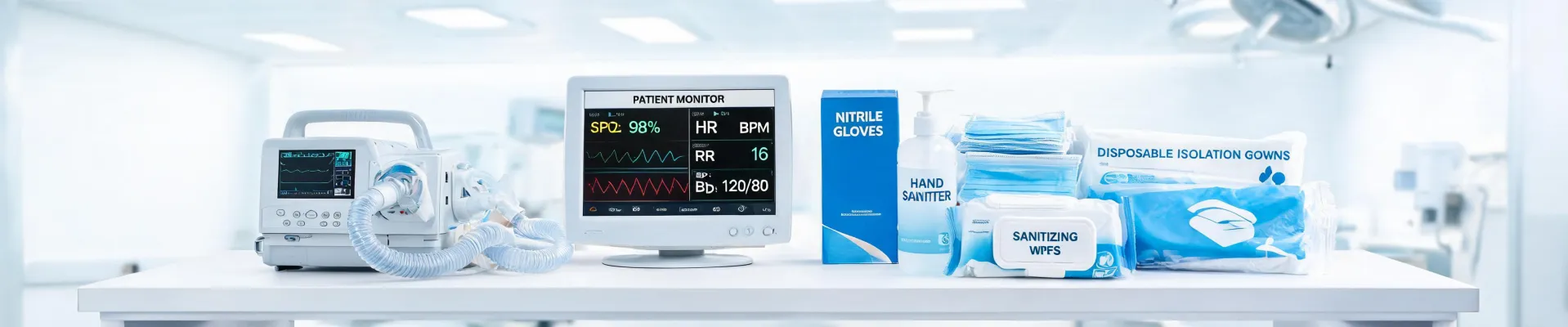
There's no universal checklist for medical equipment purchases. A walk-in clinic, a surgical center, and a diagnostic lab are solving completely different problems, and pretending otherwise leads to wasted budgets and wrong purchases. I've spent the last six years coordinating equipment procurement for healthcare facilities across the Hamilton region — handling over 200 rush requests in that time, including same-day turnarounds for facilities that couldn't cancel the next morning's cases. The biggest mistake I see isn't choosing the wrong brand. It's facilities buying what worked for someone else instead of what fits their own workflow.
So before you search for "hamilton medical equipment" or visit a medical supply store in Hamilton, figure out which of these four situations you're in:
- Scenario 1: Independent clinic or private practice
- Scenario 2: Surgical center or hospital ward
- Scenario 3: Diagnostic or specialty center
- Scenario 4: Emergency or unscheduled replacement
Each one comes with different priorities, different budget calculations, and different risks. Here's the breakdown.
Scenario 1: The Independent Clinic or Private Practice
If you're running a family practice, walk-in clinic, or urgent care, your core equipment list is relatively short: exam tables, vital signs monitors, basic diagnostic instruments, and maybe an ECG. The focus here is reliability and staff familiarity.
One thing I tell every clinic owner who asks: the monitor is only half the equation. Knowing how to read vital signs correctly matters more than the screen size or brand. A budget monitor and a premium monitor produce the same heart rate and blood pressure numbers. The premium version buys you durability, data integration, and better support — but it doesn't replace training.
As a reference point, the adult ranges most practices use as baselines are:
- Heart rate: 60–100 beats per minute
- Blood pressure: under 120/80 mmHg
- Respiratory rate: 12–20 breaths per minute
- Oxygen saturation: 95–100% on room air
- Temperature: approximately 36.5–37.5°C (97.7–99.5°F)
Post these near your exam rooms. It sounds basic, but I've walked into clinics where staff couldn't reliably interpret an SpO2 reading under 90%. That's a training issue, and no equipment purchase will fix it.
For budget: a decent, NIBP-capable vital signs monitor runs roughly $500–$2,500 depending on whether you need ECG, SpO2, and thermometer integration. This pricing was accurate as of Q4 2024. The market moves around, so verify current rates before planning your spend.
Scenario 2: The Surgical Center or Hospital Ward
If your facility performs any surgical procedures — even minor ones — the autoclave machine is the backbone of your entire operation. This is the last place you should cut corners, and it's also where I see the most predictable mistakes.
ANSI/AAMI ST79 is the standard that governs steam sterilization in healthcare facilities. It covers cycle parameters, loading practices, biological monitoring, and documentation. If you're evaluating an autoclave, check that it can meet the required cycles — typically 121°C for gravity displacement sterilizers or 132–135°C for vacuum-assisted units — and that the chamber capacity fits your instrument load.
Here's what most people get wrong: they size the autoclave for an average day, not a peak day. In my first year of procurement work, I made this exact mistake. I assumed a mid-range tabletop autoclave would handle a clinic's instrument load, and it ended up 40% too small for their procedure days. Staff had to run three extra cycles every afternoon, and turnover between cases took twice as long.
Not ideal, but workable. And it cost a restocking fee and an awkward phone call to fix.
Practical guidance: if your facility runs 10–15 instrument sets per day, don't buy the autoclave sized for 8. Buy one that handles 20. The upfront difference is usually a few thousand dollars; the operational cost of under-capacity is paid every single day.
Budget lines, as of Q4 2024: dependable tabletop autoclaves land around $2,000–$8,000 depending on chamber size and vacuum capability. Floor-standing units for hospital CSSD departments run considerably higher. Confirm current prices through a reputable medical supply store before you commit.
Scenario 3: The Diagnostic or Specialty Center
Gastroenterology clinics, ENT practices, and other specialty centers have a different kind of purchasing problem. Their defining piece of equipment is often an endoscope, and this is the category where quality differences become impossible to hide.
An endoscope isn't a commodity purchase. You're investing in a precision optical instrument — $10,000 to $30,000 per scope before you add the processor, light source, and monitor. And unlike vital signs monitors, where budget options perform roughly the same, a lower-end scope produces visibly worse images.
Here's the quality perception reality: the images from your endoscope follow the patient's record. Referring physicians review them. Patients' families see them. If those images are dim or grainy, it shapes how everyone views your facility's standards — no matter how skilled your clinician is.
I worked with a clinic that tried to save $4,000 on a budget scope for their GI practice. Within three months, the lead physician asked them to revisit the decision because image quality was affecting her ability to identify subtle mucosal changes. The savings on the device weren't worth the cost to her confidence or the clinic's reputation.
One more thing: budget for reprocessing. Endoscopes require high-level disinfection after every use, and the systems plus consumables add a recurring expense that facilities often overlook when they're calculating the total cost. A scope that sits in the clinic looks good on a brochure; a scope that's ready for the next patient is what actually matters.
Scenario 4: The Emergency or Unscheduled Replacement
Sometimes you don't have the luxury of a planned purchase. Equipment fails. It usually happens at the worst possible time — a week before an inspection, at the start of flu season, or right after you submitted next year's budget.
When I'm triaging an emergency equipment request, I run through three questions in order:
- How many days can you operate without this device?
- Can a rental or a shared agreement with an affiliated facility bridge the gap?
- If you must buy now, what's the fastest credible delivery timeline?
Here's the counter-intuitive part: in an emergency, a certified refurbished unit from a reputable vendor is often the right call. A lot of buyers hesitate because "refurbished" sounds risky. But for devices like autoclaves and surgical tables, refurbished units are frequently inspected, reconditioned, and warranted by specialized vendors — and available in days instead of weeks.
In March 2024, a surgical center called me at 4 p.m. on a Wednesday. Their autoclave had failed the morning of a scheduled inspection that Friday. The lead time on their preferred new model was five weeks.
We found a refurbished unit with a 36-hour delivery window, paid a $900 expedite fee on top of the $4,800 base cost, and had it installed and qualified with an hour to spare before the inspector arrived.
So glad we had that vendor relationship. The alternative was failing the inspection, rescheduling two days of procedures, and answering a lot of awkward questions.
Determining Which Scenario Applies to You
Still not sure where you fall? Work through these questions in order:
- Are you buying for a new facility? Then you're in scenario 1 or 3. Ask yourself whether you'll be performing invasive diagnostics. If yes, skip ahead to the endoscope conversation. If no, start with core diagnostics.
- Do you already perform surgical procedures? Then your autoclave capacity is your limiting factor. Resolve scenario 2 before you invest anywhere else.
- Is a current device out of service or failing? You're in scenario 4 until the problem is resolved. The other purchases can wait; this one can't.
- Is your facility in a growth phase? If you're expanding within the next 12–18 months, buy for the facility you're going to be, not the one you are today. Under-sizing sterilization and diagnostic capacity now means spending twice later.
One thing I can't overstate: build a relationship with a reliable medical supply vendor before you need them. Whether you're working with a local medical supply store in Hamilton or browsing the hamilton-medical catalog for equipment specs, it's a thousand times easier to resolve a crisis with a vendor who knows your facility, your equipment history, and your approval process. Emergency procurement with a cold call is possible. It's just a lot more expensive and stressful.
Quality as a Reflection of Your Facility
I've seen facilities try to save money on equipment in ways that ended up costing them far more in reputation. A patient noticing a cracked exam table. A referring physician squinting at low-resolution images. A sterilization log with skipped cycles because the autoclave couldn't keep up. These are the details that shape how your facility is perceived.
That doesn't mean you need the most expensive option in every category. It means you need equipment that's reliable, correctly specified for your workload, and backed by a vendor who picks up the phone.
That's the standard I'd measure every purchase against — because in healthcare, the equipment you choose is a direct reflection of the care you deliver.
And one final note: medical equipment pricing and lead times change quickly. This guidance was accurate as of Q1 2025, but verify current product specs, availability, and certifications like ISO 13485 before you finalize any purchase decision.

Elena Varga
Elena Varga is a medical imaging systems analyst covering CT scanners, MRI systems, ultrasound platforms, digital radiography, mammography, and ophthalmic imaging equipment. She references IEC 60601-2-44 for CT safety and essential performance while examining CTDIvol, dose-length product, spatial resolution, slice thickness, field uniformity, throughput, uptime, and DICOM interoperability. Her work helps radiology leaders, medical physicists, biomedical engineers, and procurement teams compare image quality, radiation management, workflow integration, serviceability, and lifecycle cost.