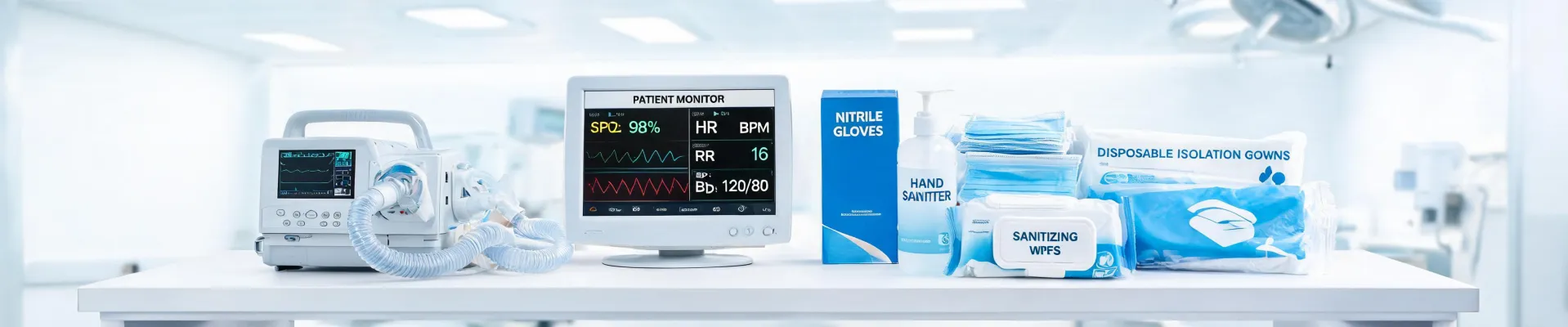
I've spent seven years inspecting medical devices, and I'm convinced the most important question isn't "what's the best brand?" It's "what happens when this device is under real clinical stress?" I review roughly 200 production batches a year as a quality manager at Hamilton Medical. In 2024, I rejected 6% of first builds for problems like sensors that drifted out of tolerance or enclosures that didn't seal. **If a pulse oximeter or patient monitor gives you a number you can't trust, every other feature on that screen is just decoration.**
That mindset tends to surprise people. A lot of our conversations start when someone searches for Hamilton Medical Center physicians or Hamilton Medical Group in Hamilton Township. They're usually looking for a clinic or a doctor, but they end up asking us about equipment: "Is this nebulizer machine safe?" "Can I trust this patient monitoring system?" "How does a pulse oximeter work, really?" The answer is simpler and harder than most vendors admit: it depends on validation, consistency, and honest limits.
Why I Care About Batch-Level Reliability
I'm not an engineer who designs sensors. I'm the person who tries to break them before you rely on them. My team tests devices against published specifications, but we also test things like storage humidity, a sticky alarm button, and how the software behaves after a power blip.
The March 2023 incident still bothers me. We got a production run of 50 patient monitoring system boards where two had intermittent Bluetooth drops. Two out of 50 might sound like a passing grade, but if that's your waveform link between the monitor and the central display, the answer is no. We rejected the whole batch. It cost time and money, but it taught me something I still say in every meeting: reliability is not a product-line property. It's a batch property.
It took me years and too many near-misses to understand that. Early on, I would look at a manufacturer's spec sheet and assume every unit matched the golden sample. Now I know the golden sample is the best one, not the typical one. (Which, honestly, is exactly why quality inspections exist.)
How Does a Pulse Oximeter Work?
Let's get technical for 90 seconds. A pulse oximeter shines two wavelengths of light through a thin part of the body, usually a fingertip. Roughly 660 nm red and 940 nm infrared light are used because oxygenated hemoglobin and deoxygenated hemoglobin absorb them differently. Oxygenated hemoglobin absorbs more infrared and less red; deoxygenated hemoglobin does the opposite. The sensor measures the ratio of these absorbances during each pulse wave, then estimates SpO2.
The key word is estimate. Pulse oximetry is not a blood gas measurement. It gives you a calculated saturation that assumes things like normal pulse morphology and adequate perfusion. I'm not 100% sure every home-use device makes that clear, but a quality device should at least show a reliable pleth waveform. If you see good steady waveform and a stable number, you can generally trust the reading. If the waveform is erratic or there's no waveform at all, the number is a guess. (I really should put that on our customer-facing packaging.)
For patient monitoring, the SpO2 module is just one piece of the puzzle. But if the pulse oximeter portion of a patient monitoring system is bad, the rest of the device doesn't matter. In my experience, cheap or unvalidated sensors are the most common reason facilities get misleading oxygen numbers. The fix isn't a trick; it's proper testing.
What I Look For in a Patient Monitoring System
A patient monitoring system usually tracks ECG, SpO2, blood pressure, respiratory rate, and sometimes temperature. When we evaluate one, I focus on four things beyond basic accuracy:
- Alarm trustworthiness — too many false alarms makes staff mute everything. A quality monitor should have clinically relevant alert thresholds, not just beeping at every motion.
- Waveform fidelity — a smooth pleth and clean ECG trace matter more than a giant color screen.
- Battery and power behavior — if the battery drops to 20% and alarm limits reset silently, that's dangerous.
- Actual usability — if your nurses need a certification to navigate menus, they'll abandon the good safety features.
I'll admit this is a hill I'll die on: you don't need 14 monitoring parameters. You need the ones your staff will actually use and trust. Some of the most impressive systems we've tested fail at fundamentals like alarm fatigue. A simpler patient monitoring system with honest alarm behavior will keep patients safer than a feature-packed one that nobody believes.
Choosing a Nebulizer Machine Without Overpaying
Nebulizer machines are less glamorous than monitors, but the quality issues are just as serious. The important specs are particle size, residual volume, noise, and consistency. For the drug to reach smaller airways, the aerosol droplet size should mostly be in the 1 to 5 micrometer range. If the machine can't produce that consistently, medication doses become unpredictable.
I also care about what's left in the cup after treatment — the residual volume. A poorly designed nebulizer can trap a significant portion of the medication. That's wasted medicine and worse outcomes. (Not to mention the patient who notices their prescription doesn't last as long.)
One thing that frustrates me is the assumption that small buyers need weak support. We get inquiries from solo practices that want a single nebulizer machine and by the end of the month they're ordering for the whole department. Treating them like a nuisance is a mistake. A good manufacturer should make you feel as valued when you buy one unit as when you buy a hundred. Small doesn't mean unimportant—it means potential.
Where My Advice Has Limits
I can only speak from the middle of the supply chain. I inspect devices from a manufacturing quality standpoint. I don't work bedside, and I'm not a pulmonologist or a veterinarian. If you're a home user with a portable monitor, a small clinic with limited WiFi, or a large hospital with a fleet of biomedical engineers, your questions will be different.
This approach worked for us, but we are a mid-sized manufacturer with in-house calibration labs and a dedicated quality team. If you're a private practice renting equipment on a short-term basis, you may care less about long-term consistency and more about quick replacement. Those are both legitimate needs. The danger is pretending one device fits both scenarios.
So don't ask me "which brand is best." Ask yourself: "Which device would fail safely in my clinic?" Every device eventually fails. What separates a good one from a mediocre one is whether the failure is obvious and honest, or silent and misleading.

Elena Varga
Elena Varga is a medical imaging systems analyst covering CT scanners, MRI systems, ultrasound platforms, digital radiography, mammography, and ophthalmic imaging equipment. She references IEC 60601-2-44 for CT safety and essential performance while examining CTDIvol, dose-length product, spatial resolution, slice thickness, field uniformity, throughput, uptime, and DICOM interoperability. Her work helps radiology leaders, medical physicists, biomedical engineers, and procurement teams compare image quality, radiation management, workflow integration, serviceability, and lifecycle cost.