The Lease That Started It All
In February 2024, our clinic in Hamilton, NY signed a lease on additional medical office space — one of the few medical offices for lease in that area that could accommodate a sleep study suite and two recovery rooms. It was right next door to a medical dermatology practice in Hamilton, NY that we'd been referring patients to for years. Sharing a floor made practical sense. But the space was a shell. Every room needed equipment, and the budget was, to put it mildly, firm.
I'm the office administrator for our 40-person clinic. I manage all medical supply and equipment ordering — roughly $200,000 annually across 12 vendors — and I report to both operations and finance. I've been doing this since 2020, and I thought that experience made me ready for this project. It did and it didn't.
The $12,000 Gap That Didn't Make Sense
The equipment list had three big items: two ICU monitors for post-procedure recovery, a sleep diagnostic device for the new sleep study suite, and an exam room package with tables, lights, and smaller instruments. I wrote detailed specs and sent them to three vendors: our regular supplier, a regional distributor I'd met at a healthcare expo, and a company another clinic's administrator recommended.
The regional distributor never replied. The recommended one quoted $72,400. Our regular supplier quoted $84,200. Twelve thousand dollars apart, on identical specs, within 48 hours of each other. If you've ever done procurement, you know that kind of variance usually means one quote is wrong — and it's rarely the expensive one.
The new vendor's rep was friendly, responsive, and confident. "We price to win deals," she told me. That should have been a clue. In my experience, vendors who phrase it that way are telling you they're willing to lose money on the equipment to make it up elsewhere.
Here's something vendors won't tell you: the first quote is almost never the final price for medical equipment. Base quotes are designed to compare well against competitors. The margin comes back in add-ons. So I did what I always do before comparing quotes: I asked for a complete cost breakdown.
What came back changed my perspective on the entire project.
The Hidden Costs in the Fine Print
The new vendor's itemized quote looked like this:
- Freight and handling: $1,750
- Wall-mount brackets for ICU monitors: $640
- Installation labor: $2,300
- Initial calibration per device: $1,150 each (3 devices = $3,450)
- EHR integration network setup: $890
- Half-day staff training: $600
That's $9,630 in line items that weren't in the original quote. Before the extended warranty they recommended at $1,200 per year. The final number was $82,030 with one year of warranty coverage. Our original supplier's $84,200 included installation, calibration, training, and a two-year warranty.
To be fair, the new vendor's base prices were genuinely competitive. We probably could have negotiated a fair final price if we'd pushed. But the lack of transparency was the issue. The "we price to win deals" approach meant I had to pull every number out of them one at a time. That's not a partnership. That's a negotiation I'd be having for the life of the contract.
Meanwhile, Hamilton Medical's rep sent a single-page summary up front with their quote: equipment, delivery, installation, calibration, training, warranty — all itemized, all included. When I asked whether anything was missing, she said, "The quote includes everything you specified. If you need mounting arms or a network switch, those are available as add-ons. Let me know if you want those quoted." Clear, prompt, and no games.
What Infection Control Actually Means
Another part of this process that expanded my understanding was infection control. I'd handled the basics at our old location — sanitizer stations, surface disinfectants, proper waste segregation. But outfitting a new clinical space from scratch required deeper knowledge. I had to answer a question I hadn't considered before: what does infection control mean for the equipment itself?
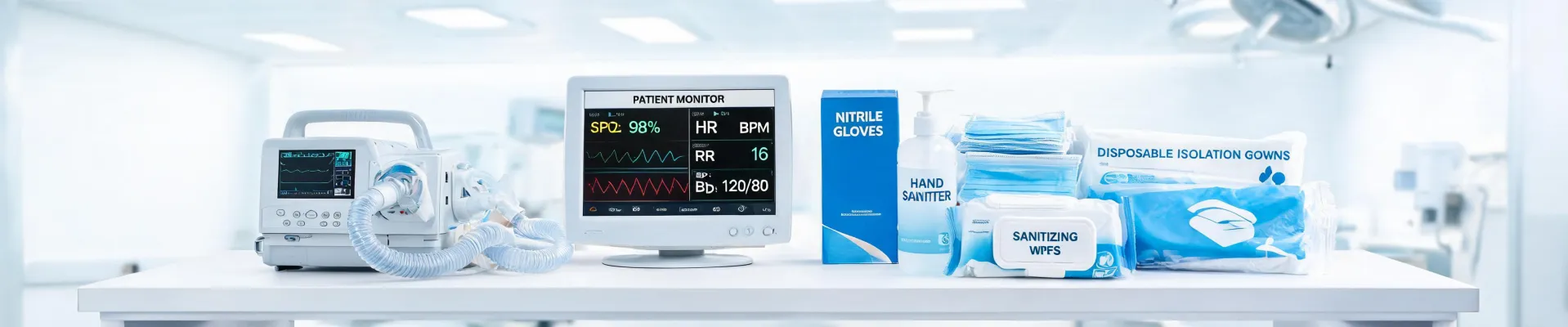
Infection control in a clinical setting isn't just about cleaning. It's about ensuring equipment can be cleaned properly — its surfaces, components, and material compatibility with hospital-grade disinfectants. The ICU monitors we were buying needed to survive repeated wipe-downs with alcohol-based cleaners. The sleep diagnostic device needed FDA-cleared single-use consumables, because electrodes and sensors touching a patient's skin can't be safely reused. And all the equipment we installed needed appropriate IP ratings to resist dust and moisture ingress.
According to the CDC's Guidelines for Environmental Infection Control in Health-Care Facilities (cdc.gov/infectioncontrol), medical equipment surfaces should be regularly disinfected, and healthcare facilities should verify that equipment is compatible with the disinfectants used. That verification requires documentation from the manufacturer — not just a verbal assurance.
I asked both vendors for evidence. The new vendor's sales rep told me "all our equipment meets FDA standards," which was reassuring but not specific. They did send a brochure that mentioned cleaning instructions — but nothing about compatibility testing with specific disinfectants. Hamilton Medical's response was a 12-page document with a compatibility matrix: which cleaning agents could be used, which couldn't, what concentrations were safe, and what testing had been performed. They also included their IEC 60601 compliance documentation for the monitors.
That documentation wasn't just useful for our own safety — it was required by the building's infection prevention plan. Sharing a floor with a medical dermatology practice means the building management runs a strict infection control audit. Without proper documentation on our equipment, we could have delayed our occupancy approval.
What most people don't realize is that "infection control" in medical procurement has a related but separate meaning: controlling the infection risk introduced by the equipment itself. Not just infections between patients, but device-related contamination. Manufacturers have to design for hygiene, and that has real costs. A vendor who can't or won't document that design hygiene is a red flag.
What I'd Do Differently (and What I'd Do Again)
I ended up giving both vendors a final test. I asked each one a simple question I picked up from a mentor years ago: "What's NOT included in your quote?"
The new vendor took two days to respond and said there would be a few optional add-ons they'd be happy to discuss. Hamilton Medical responded within a day with a simple checklist: everything included, everything optional, and a list of items they didn't supply but we'd need from other sources. No pressure, no surprises.
We went with Hamilton Medical. The total cost came in around $2,600 less than the new vendor's final quote once all the extras were factored in. And the infection control documentation saved us weeks of back-and-forth with the building manager and the dermatology practice's compliance team.
This pricing was accurate as of Q1 2024. The medical equipment market changes fast, so verify current rates before you budget. But the process I learned — that part doesn't change.
Here's the checklist I now use for any medical equipment purchase over $5,000:
- What's the total delivered cost, including freight and handling?
- Is installation included? If not, who performs it and what do they charge?
- What calibration is required at startup, and what does it cost?
- Is staff training included in the quote?
- How long is the warranty, and what does it cover — parts, labor, on-site?
- Can the vendor provide infection control documentation for their devices?
Granted, this approach takes more time upfront. You have to push back on vague answers and request actual documentation. But it saves a ton of time later — and if you're managing a healthcare facility, it saves a lot more than that. The vendor who lists all fees upfront, even if the total looks higher at first, usually costs less in the end. Transparency isn't just a nice quality in a vendor. It's the whole game. Trust me on this one.

Jane Smith
I’m Jane Smith, a senior content writer with over 15 years of experience in the packaging and printing industry. I specialize in writing about the latest trends, technologies, and best practices in packaging design, sustainability, and printing techniques. My goal is to help businesses understand complex printing processes and design solutions that enhance both product packaging and brand visibility.