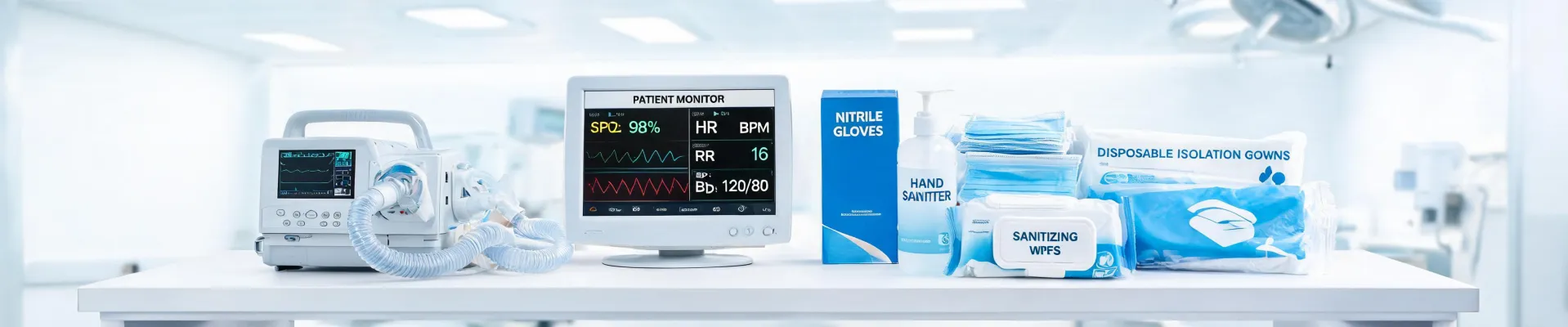
Everything I'd read about buying medical equipment said the same thing: focus on clinical evidence, compare spec sheets, choose the most advanced option your budget allows. After four years as a quality compliance manager at a medical device company—reviewing roughly 200 unique products a year before they reach customers—I've learned the situation is more complicated. The right equipment depends entirely on who you are and what you're trying to do.
In Q1 2024, for instance, we rejected a batch of 800 label rolls because the blue was visibly off—Delta E 6.2 against our Pantone spec. The standard tolerance for brand-critical colors is Delta E less than 2. The printer claimed it was "within industry standard." It wasn't, and they reprinted at their own cost. My point isn't about labels; it's that the cheapest quote stops being cheap the moment the spec fails. That principle—total cost of ownership, not unit price—runs through every scenario in this guide.
I'll walk through four common situations: the small clinic, the hospital department upgrade, home care, and the vintage collector (yes, really). Find the one that sounds like you.
Scenario A: You're Equipping a Small Clinic or Private Practice
If this is you, your reality is: one person handles procurement, staff members wear multiple hats, and every delay costs a patient's trust. You need equipment that's reliable, not necessarily cutting-edge.
Take the ECG machine decision. A 12-lead ECG with basic interpretation covers routine screening at a family practice. You don't need research-grade signal processing. The trap runs in the other direction: the cheapest imported unit with no local service presence. I've watched those fail in the first six months. The true cost isn't the $900 replacement; it's the 40 patients you had to reschedule while you waited.
When you compare ECG machine quotes, ask what's included before you look at the number. Installation. Staff orientation. Calibration schedule. Loaner equipment if it breaks. The $5,200 bare unit often becomes $8,400 once you attach those line items. The $6,800 all-inclusive quote was actually cheaper.
Documentation quality belongs in this calculation too. We require all manual graphics at 300 DPI at final size, because a diagram that turns to mush in print can lead to misuse, and misuse in a clinical setting is a liability—not an aesthetic issue.
If you need a transport ventilator, Hamilton Medical is worth putting on your shortlist. Their compact units suit smaller facilities that don't have a dedicated respiratory therapy team. But as with the ECG, compare specs against your actual patient mix, not against a brochure. The brand's reputation is not a substitute for your own TCO math.
Scenario B: You're Upgrading a Hospital Department or Lab
Larger facilities face a harder problem: not finding a good device, but finding one that fits the ecosystem it's joining. The purchase travels through clinicians, biomedical engineers, infection control, and finance—every layer adds a different cost consideration.
If you've ever asked yourself "how does PCR work," you already know the core answer: PCR amplifies a specific DNA sequence through repeated cycles of heating and cooling. What's less obvious is how much that answer matters for equipment procurement. An instrument that overshoots temperature targets degrades the reaction. Degraded reactions force reruns. Reruns are pure cost: reagents, technician time, and delayed results.
But here's the part most buyers miss: reagent compatibility. Some PCR platforms use open chemistries; others lock you into proprietary kits. The instrument quote might look excellent, but multiply the per-run reagent cost by the 5,000 runs the lab will perform over the platform's lifetime, and the capital price shrinks into a rounding error. The conventional wisdom is to compare instrument throughput and sensitivity. My experience from post-delivery cost reviews with hospital customers suggests the more important metric is reagent cost per reportable result.
Service contracts follow the same logic. A 5-year agreement on a $40,000 analyzer looks like an unnecessary line item. Until a circuit board fails on a Saturday and the lab loses 200 tests of capacity. Annual service agreements in this category run 8 to 15% of capital cost, based on what I see in hospital contracts. One weekend of lost capacity at a busy facility is often worth more in delayed reimbursements than the entire annual fee. That's not pessimism. It's arithmetic.
Scenario C: You're Buying for Home Care or Long-Term Care
Home care is where total cost thinking pays off most visibly, because the costs repeat weekly instead of once. Ostomy supplies are the clearest example I know. The pouch itself looks cheap. But the skin barrier, the flange, the disposal bags, and the fitting accessories all add up. We track customer-reported consumable costs, and switching an established ostomy patient to a cheaper pouch line to save $0.18 per unit almost always backfires—the new flange doesn't fit the barrier system they're already wearing, nursing time goes up, skin irritation comes back, and the savings disappear.
Maybe $0.22, I'd have to check the last purchase order. The point stands: the per-unit price was never the real cost.
For ECG monitoring at home, the questions are simpler. Is the device cleared for home use? That's a regulatory distinction, not a marketing one. Does it use standard AAMI connector electrodes, or proprietary ones? Proprietary electrodes cost more per test and chain you to a single vendor for as long as you own the device. It's the same consumable lock-in trap as the PCR platform, scaled down to a household budget.
(Note to self: I should write a full breakdown of consumable compatibility across product categories. It comes up every month, and I keep answering it by email instead.)
Scenario D: You're Shopping for a Vintage Hamilton Medical Cabinet
The search data still surprises me: thousands of people a year look for vintage hamilton medical cabinet pieces. These mid-century steel-and-enamel units—lab storage cabinets, surgical dressing stands, instrument cases—have a real following among collectors and clinic owners who want period aesthetics. Quick clarification: they predate the modern Hamilton Medical, the Swiss ventilator manufacturer. Different era, different company. The provenance is part of the appeal.
Here's the honest quality-side advice. A vintage cabinet can be beautiful, and the "they don't make them like they used to" belief contains some truth: a 1950s enamel finish can outlast modern powder coating, and the steel gauge is heavier than anything in the current catalog. But restoration is the catch. A $400 cabinet with a $900 professional refinish is not automatically a better deal than a $700 new stainless steel utility cabinet with a warranty—especially if you're storing anything patient-related.
For decorative use, or for non-sterile storage like manuals and office supplies, a restored cabinet is a joy. In a patient-care area, unsealed wood, flaking enamel, and creviced hinges are contamination risks that infection control will flag immediately. If the seller calls it "medical grade," ask for documentation. It's the same rule we apply to devices: claims without verification don't pass.
How to Tell Which Scenario You're In
The scenarios overlap, and that's fine. A small hospital upgrading its step-down unit has elements of both A and B. If you're unsure, answer three questions:
- Who operates it? Trained specialists can handle complex devices. Everyone else needs simplicity, no matter how impressive the spec sheet is.
- What happens when it fails? If failure means rescheduled patients, lost revenue, or a safety event, then reliability and service speed are part of the device's price—not optional extras.
- How long do you plan to use it? A one-year temporary clinic calls for a different decision than a ten-year capital commitment. The longer the horizon, the more consumable compatibility and service agreements matter.
If you're still stuck, lay the quotes side by side and add every cost that appears after the invoice: shipping, installation, training, loaner equipment, consumables per year, calibration. Most buyers stop at the invoice. The line items after it decide the total. Every other piece of advice in this article is a variation on that one sentence.
It took me about 200 product reviews and a few expensive rejections to get comfortable saying that out loud. But it's the first thing I tell anyone who asks about buying equipment—whether it's an ECG machine, a PCR thermocycler, a year's worth of ostomy supplies, or a piece of vintage medical furniture. Calculate the total cost. Ask what happens when it breaks. Match the product to the reality you actually work in, not the one the brochure imagines.

Jane Smith
I’m Jane Smith, a senior content writer with over 15 years of experience in the packaging and printing industry. I specialize in writing about the latest trends, technologies, and best practices in packaging design, sustainability, and printing techniques. My goal is to help businesses understand complex printing processes and design solutions that enhance both product packaging and brand visibility.