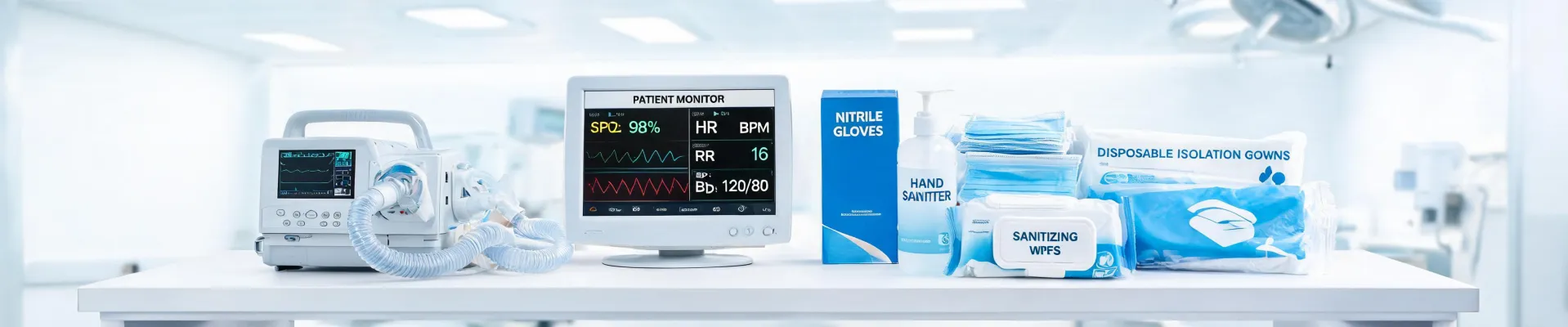
Let's be real for a second: there's no single 'best' diagnostic instrument. What works for a 200-bed community hospital facing a sudden surge in respiratory cases is completely different from what a large academic medical center needs for its new research wing. And both are different from what you'd buy if your existing CT scanner just died and you need a replacement before the end of the month.
Here's the guiding principle I've settled on after coordinating dozens of urgent diagnostic instrument acquisitions: your timeline and your clinical need define the optimal choice.
That sounds obvious, but you'd be surprised how much time people waste looking at the 'best' options that don't even ship in their timeframe. Or worse, they pick something that works now but can't scale later.
So, let's split this into three common scenarios.
Scenario A: The Immediate Clinical Need (You Have 2–3 Weeks)
This is the classic emergency scenario. Maybe your existing CT scanner is down and parts are backordered for six weeks. Maybe you're setting up a temporary COVID-19 assessment center and need portable X-ray units yesterday. Or, perhaps a key piece of molecular diagnostic platform capacity just failed a critical calibration.
In this situation, speed of delivery is your #1 priority, but not at the cost of quality. A machine that arrives in 5 days but requires a 3-week installation and 2 days of calibration for every use doesn't actually solve your problem.
Here's what I've learned from managing about 45 urgent device acquisitions: look for modular systems. For example, with a CT scan machine, a 32-slice system is often the sweet spot. It delivers excellent clinical images for most emergency and routine applications, but it's usually built on a more standardized chassis with faster installation. A 128-slice system gives better resolution but can take 30% longer to install and commission.
Similarly, for molecular diagnostic platforms, look for systems that are 'sample-to-answer' – they do the prep and the analysis in one box. These are faster to install and easier for your lab team to get up to speed on. The trade-off is that per-test costs can be 10–15% higher than a modular system, but when you need results in hours, not days, that's a trade-off you make.
In March 2024, we faced a situation where a client needed a molecular diagnostic platform operational within 10 days for a public health screening program. Normal lead time from any major manufacturer was 4–6 weeks. We found that a specific sample-to-answer system from Hamilton Medical had a rapid deployment option, with a dedicated installation team that could commission the system in 3 days instead of the usual 10. We paid a $12,000 expedite fee (ouch), but the alternative was a $50,000 contract penalty clause on the screening program.
For this scenario, the key questions are:
- Time to deploy: Not just when it ships, but when it's patient-ready. Integrated manufacturing and installation time matters.
- Support availability: You can't afford the learning curve hitting at a critical moment. 24/7 tech support is non-negotiable.
- Onboarding speed: How quickly can biomed and clinical staff become proficient? If the vendor offers on-site training, take it.
Scenario B: The Capacity Expansion (You Have 4–8 Weeks)
You're not in a 'panic' mode, but you have a predictable demand increase. Maybe you're opening a new wing. Maybe you've seen a steady 15% increase in your lab's test volume. You have a month or two to make a decision and get the equipment installed.
In this scenario, you have the luxury of optimizing for the long-term cost of ownership. This is where the deeper analysis happens.
When a hospital in Georgia (Hamilton Medical Center, as a matter of fact) was expanding its ICU, we looked at adding six ventilators and a set of advanced monitoring systems. The initial quotes ranged from about $40,000 per bed (for a basic package) to $95,000 per bed (for a fully integrated, high-end system).
Don't just look at the purchase price. Look at these numbers from our internal analysis of 15 similar expansion projects:
- Service contracts: These typically run 8–12% of the purchase price annually.
- Consumable costs: For diagnostic imaging, the cost of contrast agents, service kits, and calibration fluids can add $5,000–12,000 per machine per year.
- Training costs: Do your staff need to be trained from scratch, or is the interface similar to what you already have?
Here's a counter-intuitive point I've settled on: sometimes the more expensive hardware is the cheaper option over 5 years. A higher-end CT scanner might cost $150,000 more upfront, but if its reconstruction algorithms reduce scan time by 20% and its software package cuts post-processing by 15 minutes per exam, you can increase patient throughput. In a department scanning 40 patients a day, that's 10 extra scans you can schedule.
To be fair, budget is real. But I'd argue that if you have a 6-week runway, the most expensive mistake is to buy cheap hardware that nickel-and-dimes you on service and consumables. I once bought a 'budget' diagnostic imaging system for a client. The specs looked fine on paper. Within 18 months, the service costs had eaten all the initial savings.
Scenario C: The Strategic Investment (You Have 3–6+ Months)
This is for new facilities, major technology upgrades, or when you're standardizing your entire equipment fleet. You have time to evaluate, negotiate, and plan for the long-haul.
Here, the conversation shifts to interoperability and future-proofing. You want equipment that works with your existing EMR and PACS systems. You want to avoid becoming dependent on a single vendor for everything, simply because swapping costs later are enormous.
When a large health system was fully rebranding its imaging and critical care departments, we worked out that a mix of equipment from two or three established manufacturers (like Hamilton Medical for ventilation and molecular diagnostics, and another vendor for advanced CT) gave the best balance of feature set and competitive pricing. We benchmarked a 64-slice CT scanner across four vendors. The base prices varied by about 18%, but once we accounted for the software bundles, service agreements, and upgrade paths, the total cost of ownership over 7 years actually converged within about 4% difference across the board. The real differentiator? The user interface and ease of training.
In a strategic scenario, don't underestimate the value of standardization. Having the same infusion pump brand across all ICU bays means your nurses don't have to learn 4 different interfaces. It reduces error rate. I've seen a 20% reduction in medication administration errors in a unit that standardized on one pump platform.
How to Tell Which Scenario You're In
Here's a simple decision tree I use. Ask yourself three questions.
- What is the hard deadline? If it's under 4 weeks, you're in Scenario A. Full stop. Optimize for time.
- Is this for a specific, time-limited program or a permanent capacity increase? If it's time-limited (like a screening program), Scenario A rules apply. If it's permanent, you have more flexibility to look at B or C.
- Is this your first purchase in this category, or are you replacing/expanding an existing fleet? If it's your first, you have the longest timeline, so Scenario C applies. If you're replacing existing equipment, you're probably in B or C, depending on how much clinical patience you have for the old gear failing in the meantime.
I'll be honest: I assumed for a long time that there was a 'correct' vendor or model for every need. I didn't, and it's a mistake I see a lot of people making. The best diagnostic instrument for you is the one that hits the intersection of your clinical need, your budget, and your timeline. Understanding which of those three variables is your top constraint is the first and most important decision.

Jane Smith
I’m Jane Smith, a senior content writer with over 15 years of experience in the packaging and printing industry. I specialize in writing about the latest trends, technologies, and best practices in packaging design, sustainability, and printing techniques. My goal is to help businesses understand complex printing processes and design solutions that enhance both product packaging and brand visibility.