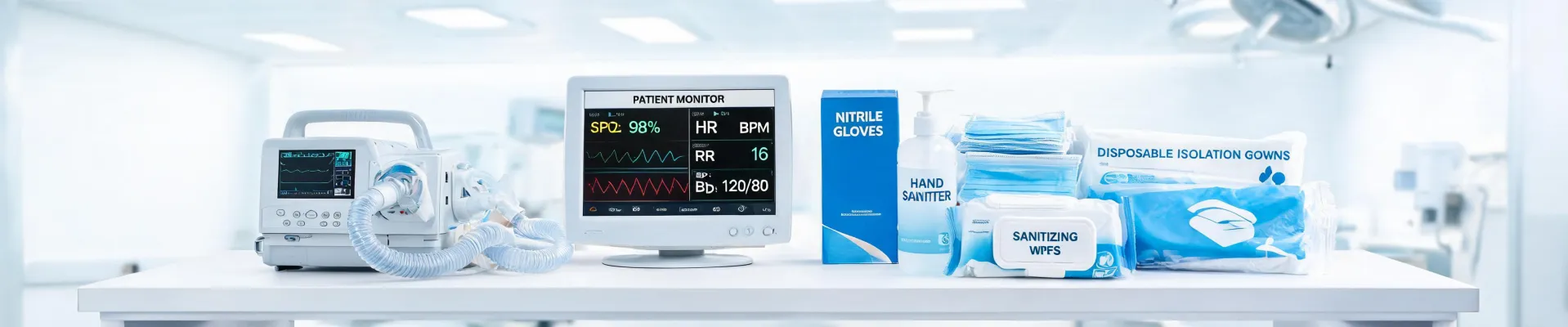
Here's a sentence I never thought I'd say as a procurement manager: the most expensive medical device is the one you have to buy twice. Wait, that's not exactly right. The most expensive medical device is the one that fails in the middle of a scheduled case, takes down an operating room, and forces an unplanned replacement. I've managed a hospital capital equipment budget of roughly $180,000 a year for six years. I've negotiated with more than forty vendors, documented every invoice, and built a cost tracking system that has saved us tens of thousands of dollars. Along the way, I became a reluctant believer in the oldest cliché in operations: prevention is cheaper than correction. It just took a few expensive mistakes to prove it.
Every time I hear someone ask what is digital radiography, or compare vital signs monitors by screen size, I think we are asking the wrong question. The question is which device costs less across the full life of the device, including the cost of failure. I used to be on the fence about that. Now I'm not.
The Price Tag Was Never the Real Cost
People think expensive vendors deliver better quality. Actually, vendors who deliver quality can charge more. The causation runs the other way. A reliable device costs more because the manufacturer spent money on engineering, testing, and support. A low-price device costs less because something was cut. Not always, but more often than not.
Example: we asked for quotes on two vital signs monitors. One bid was $2,400. Another was $1,900. I almost went with the lower number until I calculated total cost over five years. The lower-priced monitor had a separate service contract, calibration was extra, and the training session was billed as a setup service. Total cost: $4,850. The higher-priced monitor included everything, with a three-year warranty. Total cost: $3,900. That's a 20% difference hidden in the fine print.
Since then, our procurement policy requires quotes from at least three vendors, but with a standardized cost model, not just a price list. The first thing I ask for is the service history of the actual model.
Two Monitors, One Cardiac OR
Two years ago, our cardiothoracic team requested an upgrade for a heart valve replacement program. The existing vital signs monitor still worked. Finance pushed back. I have mixed feelings about that meeting. On one hand, I understand the pushback: if it isn't broken, don't buy a new one. On the other, the monitor in that room was ten years old, and the manufacturer had stopped making the calibration kit. In a heart valve replacement, the vital signs monitor is the early-warning system. If it misses a subtle rhythm change, the team doesn't know there's a problem until there's a problem.
We didn't buy the biggest model. We bought the one with a maintained calibration path, a service contract, and a training plan. It doesn't make for an impressive budget report. But it meant the OR schedule didn't shut down because of a monitor failure.
Not every decision is that dramatic. But after a few years, the pattern is clear: 5 minutes of verification beats 5 days of correction. A lesson learned the hard way.
What Digital Radiography Taught Me About Prevention
People ask, what is digital radiography? The simple answer: it's an imaging method that uses digital detectors instead of film. Images appear on a screen in seconds. Radiation dose can be lower. Storage is easier. Just about every vendor will tell you that. What they won't tell you is that the real cost advantage is fewer repeat exams.
In film radiography, you don't know whether the image is usable until the film is processed. With digital radiography, the technologist can see positioning and exposure issues on the screen and correct them before the patient leaves the room. What I mean is that the ROI is not in the image quality, but in the workflow that prevents the second X-ray.
I audited our imaging workflow in Q1 2024 and found that 11% of X-ray exams in one quarter were repeats. Most were positioning errors and wrong exposure settings. After we switched to a digital radiography system with on-screen feedback, that rate dropped to about 4% in the next six months. That saved us an estimated $8,400 a year in technologist time and patient wait times. Not bad for a system I initially thought was overpriced.
But Doesn't This Eat the Budget?
I can hear the finance director now: this all sounds good, but the budget is fixed. I can't pay for preventive maintenance on everything. To be fair, that's a real constraint. Grant money is more often than not for something shiny, rarely for the maintenance contract. I get why people skip the service plan on a device that seems fine.
Here is the number that changed my mind. A preventive maintenance contract is usually less than half the cost of one emergency replacement. And the emergency replacement includes not just the part, but the clinical downtime, the overtime, the risk of a bad outcome, and an afternoon of filling out forms. Over six years of tracking every invoice, the savings from skipped maintenance were usually smaller than the losses when a device failed. According to ECRI Institute's annual Top 10 Health Technology Hazards list (ecri.org), equipment-related issues like alarm fatigue and inadequate maintenance have appeared repeatedly. I don't need a list to tell me what the spreadsheets say, but it helps when I have to convince a finance committee.
Also, don't let a familiar logo be the reason you skip the check. I say this as someone who has seen the Hamilton Medical Center logo on a ventilator quote and felt a wave of relief. That relief is the exact thing to be suspicious of. A logo is a brand mark, not a maintenance promise. You might see Hamilton Medical in one contract and Hamilton Medical Centre in a UK distributor's catalog. The spelling doesn't matter. What matters is whether the local representative has the spare parts, whether the technician is trained, and whether the service response time is measured in days or weeks.
Three things to request before you sign: service record, training plan, calibration schedule. In that order. If a distributor can't provide those, that's a red flag, even if the logo is one you recognize.
The Bottom Line
So here is my closing opinion, and I'm not going to soften it. The cheapest device in the catalog is rarely the cheapest device in your hospital. What is digital radiography? It's an example. Vital signs monitor? An example. Heart valve replacement? The highest-stakes example. Every one of those depends on equipment bought by someone like me, with a budget, a deadline, and pressure to cut costs.
Prevention isn't a luxury. It's the most predictable cost-control method I know. I still make mistakes. I still get surprised by hidden fees. But I no longer treat a low upfront price as a win. I treat it as an invitation to read the fine print and calculate the total cost. That's not a philosophy. It's a spreadsheet.

Jane Smith
I’m Jane Smith, a senior content writer with over 15 years of experience in the packaging and printing industry. I specialize in writing about the latest trends, technologies, and best practices in packaging design, sustainability, and printing techniques. My goal is to help businesses understand complex printing processes and design solutions that enhance both product packaging and brand visibility.