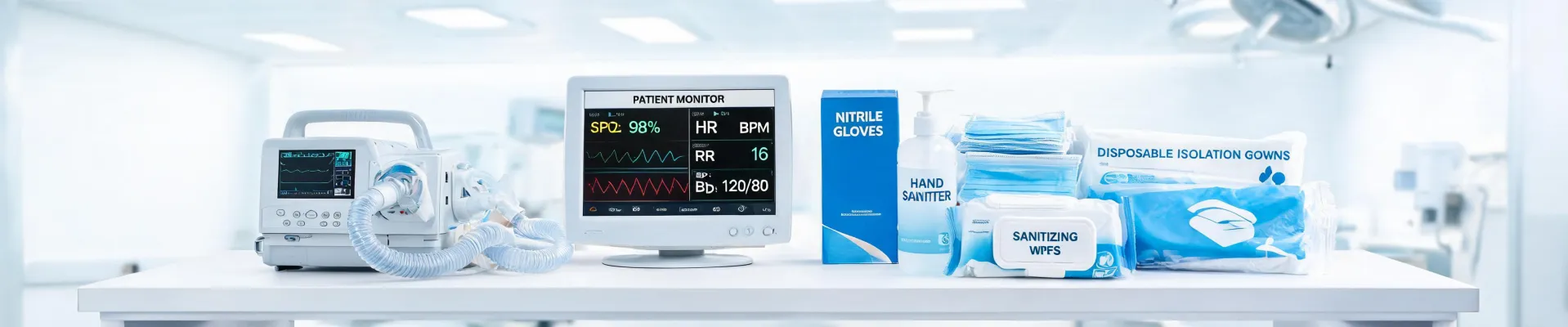
If you're buying medical equipment under a deadline, a trusted brand is a starting point, not a specification. In Q1 2024, I rejected 14% of first deliveries that came through my quality inspection queue—not because the devices were unsafe, but because the delivered product didn't match the agreed spec. The gap between a brochure and a shipping crate is bigger than most buyers expect.
That 14% number isn't a complaint about any single manufacturer. It's a reminder that “Hamilton Medical” can mean a Swiss ventilator company, and “Hamilton Medical Group” can be someone's shorthand for the Dalton, Georgia hospital behind MyChart Hamilton Medical Center. Names matter for searches. They don't matter on an incoming inspection form. What matters is whether the model number, software version, accessories, and performance data match the purchase contract.
To be clear, I'm not saying brand quality is irrelevant. It's the reason the item gets into the building. But the inspection protocol should assume that errors happen anywhere between the factory, the freight forwarder, and the receiving dock.
What I Do All Day
I'm a quality and brand compliance manager for a medical device distributor. I review roughly 200 unique items a year before they reach customers—ventilators, dental units, chemistry analyzers, single-use kits, you name it. In 2022, I implemented a verification protocol after one spec mismatch cost us $22,000 in rework and delayed an installation by 11 days. Since then, I've tracked every rejection and every root cause.
It took me 4 years and about 700 incoming orders to understand that brand reputation is a shortcut, not a destination. Put another way: the brand tells you what the manufacturer is capable of. It doesn't tell you what the distributor ordered, what the customs broker cleared, or how the unit was configured for your voltage.
In practice, that means checking the packing slip, the product label, and the user manual against the purchase order before anyone opens the sterile packaging. It also means documenting what you see with photos.
Check #1: Model Number vs. Configuration
A Hamilton Medical ventilator can be ordered with different software, pressure modes, or power cables. The model number is not enough. In 2023, we received a batch of 10 ventilators where the reference number matched but the power cable ended in a European plug instead of a US hospital-grade plug. The vendor said “within industry standard.” We rejected the batch, and they replaced the cables at their cost. Now every contract includes the exact connector type.
People sometimes ask why this wasn't caught by the vendor's own quality control. Sometimes it is caught. But when a distributor sources from multiple warehouses, the chance of transcription errors goes up. Our rule now: if a model number has more than two optional suffixes, we require the sales order to list every suffix explicitly.
Check #2: The Spec That Isn't on the Datasheet
When I compared a chemistry analyzer to another model side by side—same claimed throughput, different service access—I finally understood why “reliability” is not one number. The first analyzer required 20 minutes of daily maintenance; the second needed 5. Our lab techs rated the second one as “more reliable” even though the spec sheets said equal. On a 200-unit annual contract, that difference matters more than a 50-test-per-hour gap.
The service-access comparison taught me to ask about maintenance before the purchase. A machine that saves 10 minutes per run but costs 30 minutes a day in cleaning is not an upgrade. That's the kind of trade-off that never shows up in product marketing.
Check #3: Clinical vs. Mechanical Specs
Take a dental unit. It's a mature product, so people assume it's standardized. It isn't. The water retraction rate, the tubing material, the chair's cycle life, and the foot controller response all vary by model. In Q1 2024, we received a batch of 50 dental units where the water retraction rate was 8 mL/min against our 2 mL/min specification. The vendor claimed it was “within industry standard.” We rejected the batch. They redid it at their cost. Now every contract includes a measurable retraction requirement.
For me, an unmet spec on water retraction or power configuration is a deal-breaker, not a negotiation point. Honestly, if you can't measure it, you can't accept it.
The “What Is a Stent?” Red Flag
In 2023, someone on a requisition form asked, “what is a stent?” At first it seemed like a rookie question. But it's a red flag. If the person requesting the device can't define it, they also may not have defined the lot traceability, shelf life, or sterilization requirements. The absence of a definition is the problem, not the question.
According to the FDA (fda.gov/medical-devices), a stent is a small mesh tube that holds open passages in the body, such as blocked arteries.
When a product is defined in detail, the rest of the procurement process gets easier. When it's not, brand reputation fills the gap—and that's not a gap a name can fill. That question also matters for inventory systems. If you buy stents, you need lot numbers, expiry dates, and sterilization state to be tracked in the same system. The definition is the foundation of that traceability.
When Buying Time, Buy Certainty
Here's where the conventional advice gets it backwards. It's tempting to think you should always minimize cost. But in a deadline situation, the cheapest quote is not the safest. In March 2024, I approved a $400 rush fee for overnight shipping of a calibration standard. The alternative was missing a scheduled Friday install at a clinic—a $15,000 loss in labor and patient access. The fee wasn't for speed. It was for certainty. An uncertain delivery can turn a $2,000 part into a $20,000 scheduling problem.
That's basically why I treat “probably on time” as the biggest risk in emergency procurement. If a vendor can't confirm the ship date, the configuration, and the regulatory documentation in writing, the brand name on the invoice doesn't help.
The same logic applies to service contracts. In 2022, I paid for a premium service level on a chemistry analyzer—not because we expected frequent breakdowns, but because the cost of an unplanned repair was higher than the premium. It felt like wasted budget in a good year. Then a coolant pump failed in week 40. The premium contract had a replacement unit on-site in 18 hours. That one event justified three years of the difference.
When This Checklist Doesn't Apply
My checklist is not universal. For low-risk, off-the-shelf consumables—a replacement filter, a thermometer probe—don't overcomplicate it. At least, that's been my experience: the inspection burden should scale with the clinical risk. I should also add that hospital systems with an existing group purchasing organization (GPO) contract may not be free to impose their own specs. In those cases, you're verifying against the GPO's master agreement, not your own template.
If your organization is large enough to have a clinical engineering team, include them early. They will catch issues that procurement doesn't see, like alarm default behavior or IT integration requirements. This is not a handoff; it's a partnership.
Oh, and your receiving team needs a camera. I should add that because a damaged crate photo has saved us at least three times this year.
This was accurate as of January 2025. Medical device standards and regulatory expectations change, so verify current requirements with your FDA registration, notified body, or clinical engineering team.
Bottom line: if you don't verify, you're buying a possibility, not a product. A name like Hamilton Medical gets you in the room. A spec review keeps you safe.

Elena Varga
Elena Varga is a medical imaging systems analyst covering CT scanners, MRI systems, ultrasound platforms, digital radiography, mammography, and ophthalmic imaging equipment. She references IEC 60601-2-44 for CT safety and essential performance while examining CTDIvol, dose-length product, spatial resolution, slice thickness, field uniformity, throughput, uptime, and DICOM interoperability. Her work helps radiology leaders, medical physicists, biomedical engineers, and procurement teams compare image quality, radiation management, workflow integration, serviceability, and lifecycle cost.